
Resource Center
September 16, 2026
Pigment Selection for PVC Production: Heat Resistance, Dispersion and Color Stability | Tüver Pigment
Choosing the right pigment for PVC production is not only about achieving the desired color. Pigment selection can directly affect color stability, heat resistance, dispersion quality and production consistency throughout the processing cycle.
PVC is used in a wide range of applications, including profiles, pipes, cables, films, sheets, flooring and various technical products. Because processing conditions and formulation requirements differ between these applications, the pigment must be selected according to the specific PVC system and production process.
A pigment that provides excellent color strength may not necessarily provide the required thermal stability or dispersion performance. For this reason, PVC pigment selection should be based on a combination of technical parameters rather than color alone.
What Is PVC and Why Are Pigments Used in PVC?
Polyvinyl chloride, commonly known as PVC, is a thermoplastic material that can be modified with stabilizers, plasticizers, pigments and other additives according to the intended application.
Pigments are added to PVC formulations to provide the required color, opacity and visual appearance. Depending on the final product, manufacturers may use organic pigments, inorganic pigments or specialized pigment systems.
For example, organic pigments can be considered when bright and intense colors are required, while inorganic pigments can be selected for applications where opacity, durability and color stability are important.
Why Is Pigment Selection Important in PVC Production?
In PVC production, the pigment must remain compatible with the formulation and processing conditions. Factors such as processing temperature, residence time, dispersion conditions and the presence of other additives can influence the final color result.
An unsuitable pigment may cause problems such as color shifting, insufficient dispersion, reduced color strength or inconsistent results between production batches.
When selecting a pigment for PVC, manufacturers should consider:
- Heat resistance
- Color strength
- Dispersion performance
- Color stability
- Lightfastness
- Chemical resistance
- Compatibility with the PVC formulation
- Processing conditions
- Target color and opacity
- Required pigment dosage
Why Is Heat Resistance Important for PVC Pigments?
Pigments used in PVC processing are exposed to thermal conditions during manufacturing. Therefore, the pigment's heat resistance should be evaluated against the actual processing conditions of the PVC formulation.
If the pigment does not provide sufficient thermal stability, the color may shift during processing. This can result in differences between the laboratory sample and the final production part.
For this reason, the technical data sheet of the pigment should be reviewed before production. Heat resistance should always be considered together with the actual processing temperature and residence time of the application.
For a more detailed explanation, see our technical guide on pigment heat resistance in plastic processing.
How Does Pigment Dispersion Affect PVC Production?
Good pigment dispersion is essential for obtaining a uniform color throughout the PVC matrix. Even a pigment with high color strength may fail to deliver the expected result if it is not properly dispersed.
Poor dispersion can lead to pigment agglomeration, uneven color distribution, surface defects and batch-to-batch color variations.
Therefore, pigment selection should consider not only the pigment's color characteristics but also its dispersion behavior within the PVC formulation.
Our detailed guide, What Is Pigment Dispersion?, provides additional information about the relationship between pigment dispersion and production quality.
Common Signs of Poor Pigment Dispersion
- Uneven color distribution
- Visible pigment agglomerates
- Color streaks
- Inconsistent surface appearance
- Lower-than-expected color strength
- Differences between production batches
Why Does Color Strength Matter in PVC Pigment Selection?
Color strength, also known as tinting strength, indicates how effectively a pigment develops color at a given concentration. In PVC production, consistent color strength can help manufacturers achieve the target shade with controlled pigment dosage.
However, color strength should not be evaluated independently. A pigment with high color strength must also meet the required heat resistance, dispersion and application-specific performance requirements.
You can learn more about this parameter in our article on pigment color strength and tinting strength.
Organic Pigments for PVC Applications
Organic pigments can be used in PVC applications where bright, clean and intense colors are required.
However, not every organic pigment has the same thermal stability or application performance. The pigment should therefore be evaluated according to the processing conditions and the technical requirements of the final PVC product.
Parameters such as heat resistance, lightfastness, color strength and dispersion should be reviewed before selecting an organic pigment for a specific PVC formulation.
Inorganic Pigments for PVC Applications
Inorganic pigments are widely considered when opacity, durability and color stability are important requirements.
This pigment group includes different families such as oxide pigments, chromium oxide pigments, carbon black and titanium dioxide. Each pigment family offers different color, opacity and performance characteristics.
For example, titanium dioxide can be considered in white PVC formulations where high opacity and brightness are required.
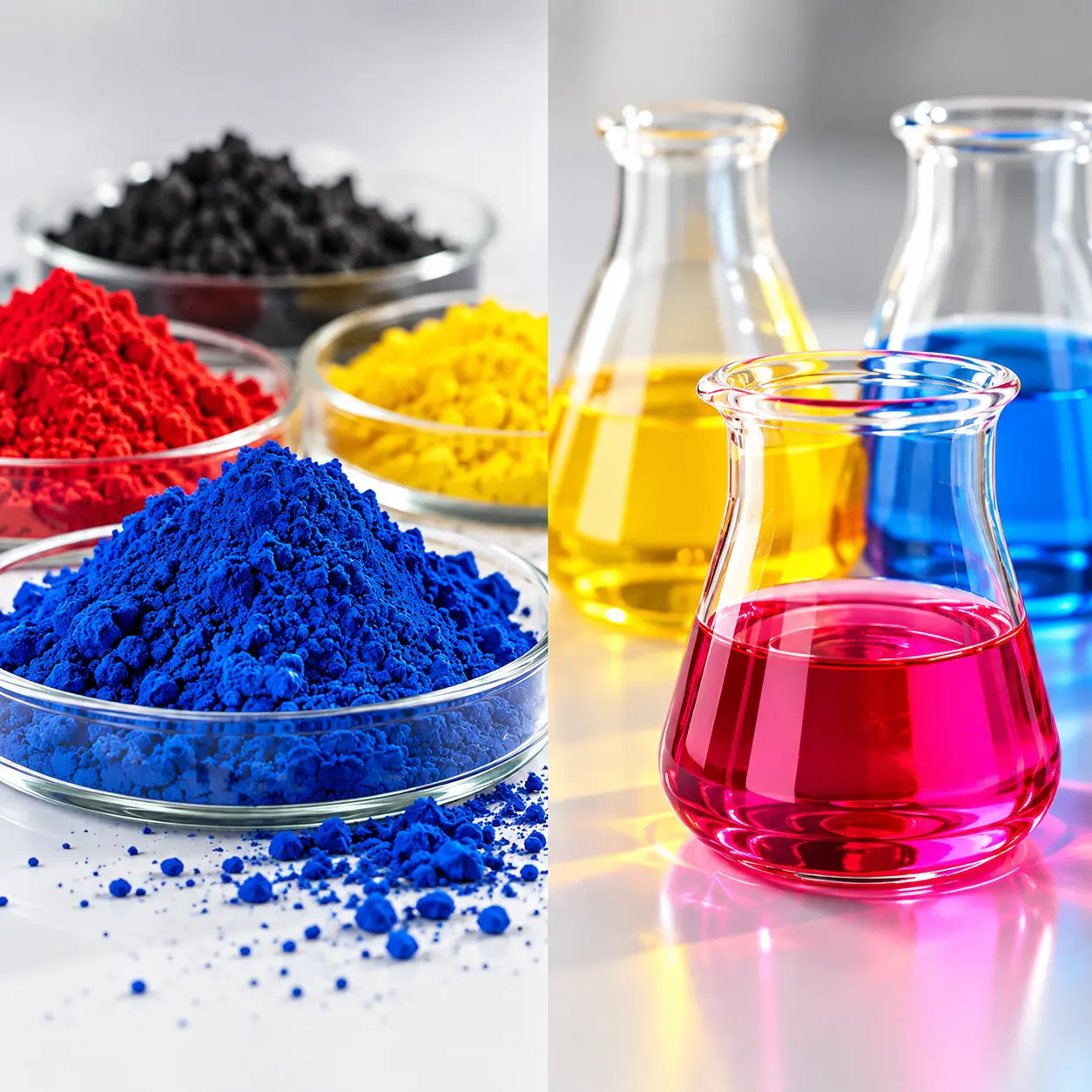
Organic and Inorganic Pigments in PVC Production
The choice between organic and inorganic pigments for PVC applications depends on the required color, opacity, thermal stability, lightfastness and overall performance of the final product. Neither pigment group is universally suitable for every PVC application.
Organic Pigments for PVC
Organic pigments are commonly considered when bright, clean and high-intensity colors are required. Depending on the pigment chemistry, they can provide strong color development and a wide range of shades.
However, the individual pigment should always be evaluated according to the actual PVC processing conditions. Heat resistance, lightfastness, chemical resistance and dispersion performance may vary significantly between different organic pigment chemistries.
Inorganic Pigments for PVC
Inorganic pigments can be preferred in applications where opacity, durability and color stability are important. Oxide pigments, chromium oxide pigments, carbon black and titanium dioxide are examples of inorganic pigment groups used in plastics and other industrial applications.
For applications requiring oxide-based shades, oxide pigments can be evaluated according to the required color and performance characteristics.
How to Choose Pigments for Different PVC Applications
Pigment requirements can change depending on the type of PVC product being manufactured. A pigment suitable for an indoor PVC product may not necessarily provide the same performance in an outdoor application.
| PVC Application | Important Pigment Criteria |
|---|---|
| PVC Profiles | Heat resistance, color stability, lightfastness and weather resistance |
| PVC Pipes | Color consistency, dispersion and processing stability |
| PVC Cables | Heat resistance, dispersion and formulation compatibility |
| PVC Films | Dispersion, color strength, opacity and surface appearance |
| PVC Sheets | Color stability, opacity, dispersion and application durability |
How to Prevent Color Variation in PVC Production
Color variation can occur even when the same pigment is used. Differences in pigment dosage, raw materials, processing temperature, residence time and dispersion conditions can all affect the final color.
For consistent production, manufacturers should establish a reference color and maintain controlled formulation and processing parameters. Pigment lots should also be monitored to minimize unexpected differences between batches.
If a color problem occurs, changing the pigment immediately is not always the correct solution. The entire production process should first be evaluated to identify the actual source of the variation.
Pigment Dosage in PVC Formulations
Pigment dosage depends on the target shade, pigment color strength, PVC formulation, opacity requirements and processing method.
Using too little pigment may result in insufficient color intensity, while excessive dosage can increase formulation cost and may affect dispersion or other processing characteristics.
Laboratory trials are therefore recommended before moving to full-scale production. Different pigment concentrations can be tested against a reference standard to determine the appropriate dosage for the application.
The Role of Dispersion in PVC Color Consistency
Good dispersion helps distribute pigment particles uniformly throughout the PVC matrix. This is particularly important in thin films, profiles and other products where surface color differences can become highly visible.
Dispersion quality depends not only on the pigment but also on the mixing equipment, processing conditions, formulation and pigment concentration.
For this reason, pigment dispersion should be considered as part of the complete formulation and production process rather than as an isolated pigment property.
Color Strength and Pigment Selection
Color strength is another important parameter when selecting pigments for PVC. A pigment with suitable color strength can help manufacturers reach the target shade with a controlled dosage.
Nevertheless, high color strength alone does not guarantee good PVC performance. The pigment must also meet the required thermal, dispersion and durability requirements of the application.
Our guide to pigment color strength and tinting strength explains how this parameter can be evaluated in greater detail.
How to Prevent Pigment-Related Color Problems in PVC Production?
When a color problem occurs during PVC production, replacing the pigment immediately may not always be the correct solution. The pigment, dosage, dispersion, processing temperature, residence time and other raw materials should be evaluated together to identify the actual cause.
For consistent production, manufacturers should establish a standardized formulation and maintain controlled processing parameters. Monitoring pigment lots can also help reduce unexpected differences between production batches.
Common Color Problems in PVC Production
| Problem | Possible Cause | What to Check |
|---|---|---|
| Color shade changes | Pigment, temperature or dosage variation | Pigment lot, dosage and processing temperature |
| Uneven color | Insufficient dispersion | Mixing and dispersion conditions |
| Weak color | Low color strength or insufficient dosage | Tinting strength and pigment concentration |
| Color becomes darker during production | Processing conditions or pigment stability | Heat resistance and processing time |
Laboratory Testing for PVC Pigment Selection
Testing a new pigment at laboratory scale before introducing it into full-scale production can help identify potential problems at an early stage.
The pigment should be evaluated within the actual PVC formulation whenever possible. Looking only at the pigment's individual technical properties may not provide enough information about its performance in the final system.
Important parameters to compare include:
- Color shade
- Color strength
- Dispersion quality
- Color change after thermal processing
- Lightfastness
- Opacity
- Batch-to-batch color consistency
Tüver Pigment Approach to PVC Pigment Selection
Instead of assuming that one pigment is suitable for every PVC product, pigment selection should be based on the technical requirements of the specific application.
PVC profiles, pipes, cables, films, sheets and other PVC products may have different color, processing and durability requirements.
Organic pigments can be considered for bright and intense colors, while inorganic pigments can be evaluated for applications requiring different levels of opacity, durability and color stability.
For oxide-based shades, oxide pigments can be selected according to the required color and performance characteristics. For white PVC formulations, titanium dioxide can be considered where brightness and opacity are important.
Other formulation requirements can also be addressed with suitable plastic additives.
What Should You Consider When Selecting Pigments for PVC?
Pigment selection for PVC should go beyond simply matching a color chart. The pigment's behavior during processing and the performance requirements of the finished product should be evaluated together.
- Determine the processing temperature: Compare the pigment's heat resistance with the actual processing conditions.
- Define the target color: Establish the required shade and color strength.
- Evaluate dispersion: Check whether the pigment can be uniformly dispersed within the PVC formulation.
- Consider the end-use environment: Evaluate indoor or outdoor exposure, light and weather conditions.
- Optimize pigment dosage: Determine the appropriate concentration through laboratory testing.
- Review technical documentation: Evaluate TDS and other available technical data.
- Conduct production trials: Test the pigment under actual manufacturing conditions before full-scale production.
The Relationship Between PVC Pigments and Masterbatch
Depending on the manufacturing system, pigments may be incorporated directly into a PVC formulation or used through concentrated color systems in certain plastic applications.
In masterbatch production, pigment color strength, dispersion performance and compatibility with the carrier system are particularly important. Our guide on pigment selection for masterbatch production provides additional information on this subject.
PVC Pigment Selection Checklist
| Parameter | Evaluation |
|---|---|
| Application | Profile, pipe, cable, film, sheet or other PVC application |
| Heat resistance | Is the pigment suitable for the processing conditions? |
| Color strength | Does it provide sufficient color intensity at the required dosage? |
| Dispersion | Can uniform dispersion be achieved within the PVC formulation? |
| Lightfastness | Is the pigment suitable for the intended exposure conditions? |
| Color standard | Is the production result compared against a defined reference standard? |
Frequently Asked Questions About PVC Pigments
Which pigments can be used for PVC?
Different organic and inorganic pigment groups can be used in PVC applications. The appropriate choice depends on the target color, processing temperature, dispersion, lightfastness and end-use requirements.
Why is heat resistance important for PVC pigments?
Pigments are exposed to thermal processing conditions during PVC manufacturing. Therefore, the pigment should maintain its required color performance under the actual processing conditions.
Why is pigment dispersion important in PVC?
Good dispersion helps distribute pigment particles uniformly throughout the PVC formulation and contributes to consistent color and surface appearance.
Should I use organic or inorganic pigments for PVC?
There is no single pigment group that is suitable for every PVC application. Organic and inorganic pigments offer different color, opacity, durability and processing characteristics. Selection should be based on the specific technical requirements of the application.
How is PVC pigment dosage determined?
Pigment dosage depends on the target color, pigment color strength, PVC formulation and other formulation components. Laboratory trials can be used to determine an appropriate dosage before full-scale production.
Conclusion: Choosing the Right Pigment for PVC Production
Pigment selection for PVC production is not limited to finding the correct color shade. Heat resistance, dispersion, color strength, lightfastness, color stability and formulation compatibility should be evaluated together.
For PVC manufacturers, testing pigments under actual processing conditions, establishing reference colors and standardizing production parameters can help achieve more consistent and controlled results.
Tüver Pigment supplies organic pigments, inorganic pigments and plastic additives for industrial and plastic applications. Contact us to evaluate pigment options according to the technical requirements of your PVC application.