September 29, 2026
White Pearl Pigment: How to Choose the Right Pearlescent Effect for Industrial Applications | Tüver Pigment
A white surface does not always have to look flat. In many industrial and decorative applications, manufacturers want a finish that combines a clean white appearance with depth, softness and controlled light reflection. This is where white pearl pigments become valuable.
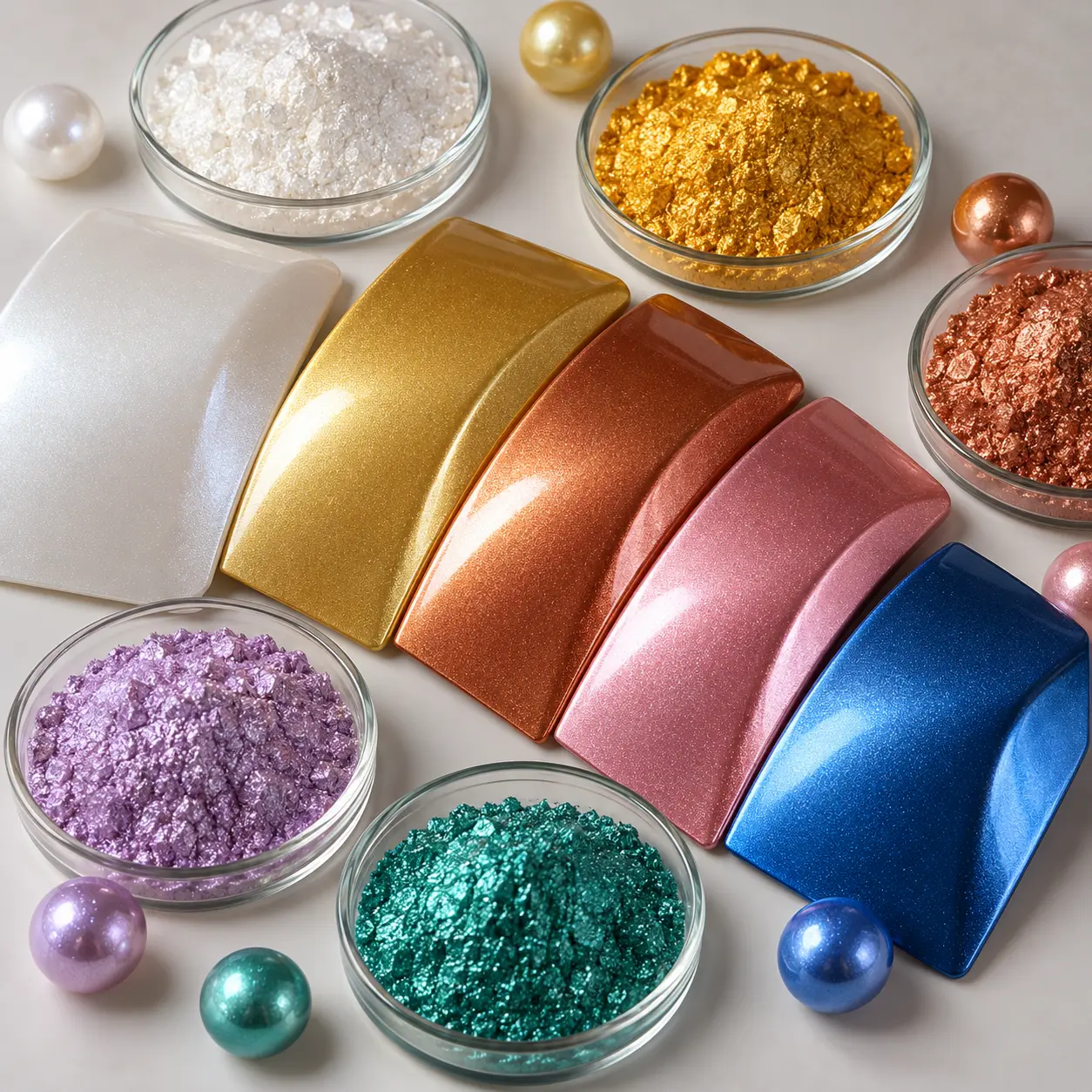
White pearl pigments are effect pigments designed to create a pearlescent appearance rather than simply providing conventional white coloration. Depending on the pigment structure, particle size and formulation, the final surface can range from a subtle satin-like pearl effect to a much more visible, brilliant shimmer.
For manufacturers, choosing the right white pearl pigment is therefore not simply a matter of selecting a white color. The required effect strength, particle size, brightness, application method, substrate and processing conditions all need to be considered.
Tüver Pigment supplies a range of pearl and effect pigments for applications where a controlled decorative surface effect is required.
What Makes a White Pearl Pigment Different?
Conventional white pigments are generally selected to increase whiteness and hiding power. A pearl pigment has a different purpose: it changes the way light interacts with the coated or molded surface.
The platelet structure of pearlescent pigments allows light to be reflected in a controlled manner. This creates the characteristic visual depth associated with pearl finishes.
As a result, two products that are both described as “white” can produce very different surfaces. One may provide a dense, opaque white, while another creates a softer white appearance with noticeable optical depth and reflected light.
White Pearl Pigment vs. Titanium Dioxide
| Feature |
White Pearl Pigment |
Titanium Dioxide |
| Primary function |
Pearlescent and optical surface effect |
Whiteness and opacity |
| Visual character |
Luminous, pearlescent and reflective |
Solid, clean and opaque white |
| Decorative effect |
High |
Not the primary purpose |
| Typical role |
Effect and appearance modification |
Color, whiteness and hiding power |
These two pigment types can also be considered within the same formulation when both opacity and a pearlescent appearance are required. The appropriate balance depends on the target finish and formulation.
For applications where high whiteness is required, Tüver Pigment also offers Titanium Dioxide products.
Synthetic Pearlescent Pigments and White Pearl Effects
Synthetic pearlescent pigments are particularly interesting when the manufacturer needs greater control over the visual characteristics of the effect. Their controlled particle structure can be used to develop different levels of brightness, softness and optical reflection.
White is one of the most widely used pearl-effect shades because it can create a clean and sophisticated finish without introducing a strong secondary color. Depending on particle size, a synthetic white pearl pigment can produce anything from a fine silky appearance to a much more pronounced sparkling effect.
This makes synthetic white pearl pigments relevant to applications where the surface appearance itself is an important part of the product design.
Why Particle Size Matters
Particle size is one of the most important parameters when selecting a pearlescent pigment. It has a direct influence on how the finished surface reflects light and how noticeable the effect becomes.
| Particle Range |
Typical Visual Character |
| Very fine particles |
Soft, smooth and subtle pearlescent appearance |
| Fine particles |
Balanced pearl effect with controlled brightness |
| Medium particles |
More visible reflection and stronger effect |
| Large particles |
Pronounced shimmer and stronger visual impact |
Particle size should therefore be selected according to the desired appearance rather than assuming that a larger particle automatically means a better pigment.
White Pearl Pigment Applications
White pearlescent pigments can be evaluated across a wide range of industrial systems. The most suitable grade depends on the formulation and the desired surface effect.
Paints and Decorative Coatings
In decorative coatings, white pearl pigments can introduce depth and a refined reflective appearance to otherwise flat white surfaces.
They can be considered for architectural coatings, decorative finishes, furniture coatings and other applications where visual appearance is an important part of the finished product.
For water-based and solvent-based formulations, compatibility with the binder system and the pigment's dispersion behavior should be evaluated before production.
Plastics and Masterbatch
White pearl pigments can also be used to modify the appearance of molded or extruded plastic products. In these applications, the pigment needs to withstand the relevant processing conditions while maintaining the desired optical effect.
Processing temperature, polymer compatibility, dispersion and particle size are therefore important when selecting a pearlescent pigment for plastic applications.
Manufacturers working with masterbatch can also evaluate pearl pigments alongside suitable plastic additives when developing a complete formulation.
Epoxy and Resin Systems
In epoxy and resin applications, white pearl pigments can create depth and a distinctive reflective appearance. The final effect can vary considerably depending on pigment concentration, resin transparency, application thickness and curing conditions.
For decorative resin applications, testing several pigment concentrations is often useful because the visual effect can change significantly with relatively small formulation adjustments.
How to Choose a White Pearl Pigment
A practical selection process should begin with the final appearance rather than the product name. Before choosing a grade, define the required level of brightness and the type of pearl effect you want to achieve.
- Determine whether the finish should be subtle or highly visible.
- Define the required particle size range.
- Check compatibility with the binder, resin or polymer.
- Evaluate the processing temperature.
- Consider the required dispersion performance.
- Test the pigment at several concentration levels.
- Compare the final appearance under different lighting conditions.
For industrial applications, a laboratory sample is particularly useful because the same white pearl pigment can produce different visual results depending on the formulation and application method.
Where Are White Pearl Pigments Used?
White pearl pigments are used whenever a standard white finish is not enough and the surface needs a more refined optical effect. Their ability to reflect light creates visual depth that can make a finished product appear brighter, softer or more luxurious.
The most suitable grade depends on the production method, substrate, particle size, required brightness and the level of pearlescent effect expected from the final product.
White Pearl Pigments in Decorative Paints
Decorative paints are one of the most suitable application areas for white pearl pigments. Instead of producing a completely flat white surface, a pearlescent pigment can introduce subtle reflection and a changing appearance as the viewing angle changes.
This effect can be used in interior decorative coatings, specialty wall finishes, furniture coatings and other architectural surfaces where appearance is an important part of the product.
The formulation should be evaluated according to the binder system, application method and desired effect intensity. A fine particle grade may be preferable for a smooth and understated finish, while a larger particle grade can create a more visible reflective effect.
For manufacturers looking for alternatives beyond white pearl pigments, Tüver Pigment's Pearl & Effect Pigments range includes different effect pigment options for decorative applications.
White Pearl Pigments in Plastics
White pearl pigments can give molded and extruded plastic products a distinctive visual appearance. They can be used where manufacturers want a clean white base combined with a controlled pearlescent or reflective effect.
Plastic applications require particular attention to processing temperature, polymer compatibility, dispersion and particle size. A pigment that performs well in a coating system may not necessarily provide the same result in a high-temperature plastic process.
For this reason, the technical requirements of PP, PE, PVC, ABS, EVA and other polymers should be considered before selecting a white pearl grade.
Masterbatch Production
In masterbatch production, white pearl pigments can be incorporated into concentrated formulations and subsequently used to create pearlescent effects in finished plastic products.
Here, color strength is only one part of the selection process. The pigment's dispersion behavior, concentration capability, thermal stability and compatibility with the carrier polymer can all influence the final appearance.
Manufacturers can also evaluate suitable plastic additives alongside the pigment when developing a complete masterbatch formulation.
Epoxy and Resin Applications
White pearl pigments are widely relevant to decorative epoxy and resin systems where a three-dimensional or reflective appearance is desired.
The final effect can vary according to resin transparency, pigment concentration, layer thickness and curing conditions. A relatively small change in pigment loading can therefore produce a noticeable difference in the final appearance.
For this reason, several laboratory samples with different pigment concentrations can be prepared before moving to production.
Coatings and Specialty Surfaces
White pearl pigments can also be considered for specialty coatings where a standard matte or glossy finish does not provide the desired visual character.
Depending on the formulation, they can be used to create a soft pearl appearance, a stronger reflective effect or a more pronounced decorative finish.
Fine vs. Large Particle White Pearl Pigments
Particle size is one of the easiest ways to influence the visual character of a pearlescent finish. However, particle size should always be considered together with the application system and target appearance.
| Particle Type |
Typical Appearance |
Potential Applications |
| Very fine |
Smooth, soft and subtle pearl effect |
Fine coatings, smooth decorative finishes and applications requiring a restrained effect |
| Fine |
Balanced brightness and pearlescent appearance |
Paints, coatings, plastics and decorative systems |
| Medium |
More visible reflection and stronger effect |
Decorative coatings, plastics and specialty surfaces |
| Large |
Pronounced shimmer and stronger visual impact |
Special-effect surfaces and decorative applications |
White Pearl Pigment Grades: How Should You Compare Them?
Not every white pearl pigment is designed to produce the same appearance. When comparing grades, manufacturers should look beyond the product name and examine the technical specifications of each option.
Tüver Pigment's white pearl pigment range includes products with different particle-size distributions, allowing manufacturers to evaluate grades according to their desired effect.
For example, KW-100 and KW-103 are available in the 10/60 µm range, while KW-120 and KW-123 are available in the 05/25 µm range. Other grades include KW-151 at 10/100 µm, KW-153 at 20/100 µm, KW-163 at 40/200 µm and KW-183 at 60/300 µm. KW-111 has a particle size below 15 µm.
These differences allow manufacturers to compare products according to the desired balance between smoothness, brightness and visible pearl effect.
How Does Particle Size Affect Pearl Effect?
Particle size can influence how light is reflected from the finished surface. Finer particles generally allow for a softer and more uniform visual effect, while larger particles can produce a more noticeable shimmer.
However, particle size should not be treated as an isolated specification. The final appearance is also affected by pigment loading, binder composition, surface preparation, application thickness and the way the pigment is dispersed.
White Pearl Pigment Selection for Different Applications
| Application |
Important Selection Factors |
| Decorative paint |
Effect intensity, dispersion, binder compatibility and surface appearance |
| Plastic |
Thermal stability, polymer compatibility and particle size |
| Masterbatch |
Dispersion, concentration capability, carrier compatibility and processing temperature |
| Epoxy and resin |
Transparency, pigment loading, dispersion and layer thickness |
| Decorative coating |
Brightness, particle size, surface quality and formulation compatibility |
Can White Pearl Pigments Be Combined with Other Pigments?
Yes. Depending on the formulation, white pearl pigments can be combined with conventional pigments to create more complex visual effects.
For example, a white pearl pigment can be incorporated into a colored system to add depth and reflected light while the base pigment provides the primary color.
The result depends strongly on pigment concentration, transparency, particle size and the color of the underlying substrate. Laboratory testing is therefore recommended before finalizing the formulation.
White Pearl Pigments and Other Effect Pigments
White pearl is only one part of the broader effect-pigment category. Depending on the desired finish, manufacturers may also consider colored pearl, metallic or other special-effect pigments.
For applications requiring a different visual effect, Tüver Pigment's Pearl & Effect Pigments range can be evaluated alongside white pearl grades.
Why Sample Testing Matters
Technical specifications provide valuable information, but the final visual result can only be properly assessed under the actual application conditions.
Before placing a larger order, manufacturers can compare several grades and concentrations by checking:
- Brightness
- Pearlescent intensity
- Surface uniformity
- Particle visibility
- Color tone
- Dispersion quality
- Processing stability
- Compatibility with the formulation
This approach is particularly useful when choosing between several white pearl grades with similar particle-size ranges but different performance characteristics.
How to Use White Pearl Pigment in a Formulation
Using a white pearl pigment successfully requires more than simply adding the powder to a formulation. The final appearance depends on how the pigment is incorporated, dispersed and applied.
In many systems, excessive mechanical stress can affect the platelet structure of effect pigments. For this reason, the dispersion process should be selected according to the formulation and equipment used in production.
Pigment Concentration
There is no single dosage level that is suitable for every application. The required amount depends on the desired visual effect, binder system, substrate and particle size of the selected pigment.
A lower concentration may be sufficient when a soft pearl appearance is required, while a stronger concentration can be evaluated when a more pronounced reflective effect is desired.
The most reliable approach is to prepare several laboratory samples using different concentrations and compare the resulting appearance after the complete application and curing process.
Dispersion Considerations
Good dispersion is essential for achieving a uniform pearlescent appearance. Poor dispersion can result in uneven brightness, visible agglomerates or inconsistent surface appearance.
White pearl pigments should therefore be incorporated using a process that provides sufficient distribution without unnecessarily damaging the effect pigment structure.
The compatibility between the pigment and the selected resin, binder or polymer should also be evaluated before production.
Common Problems When Selecting White Pearl Pigments
Several formulation problems can occur when a pearlescent pigment is selected without considering the complete application system.
The Pearl Effect Is Too Weak
A weak effect can be caused by several factors, including unsuitable particle size, insufficient pigment concentration, poor orientation of the pigment particles or an opaque base that limits the optical effect.
Increasing the pigment concentration is not always the best solution. Selecting a grade with a different particle size or optical characteristic may produce a more suitable result.
The Surface Looks Too Sparkly
If the desired appearance is a smooth and sophisticated pearl finish but the surface appears excessively sparkling, the selected particle size may be too large for the application.
A finer grade can be tested to achieve a more uniform and subtle appearance.
Uneven Appearance
Uneven distribution can be related to dispersion, application thickness, formulation compatibility or processing conditions. The pigment should be evaluated under the actual production process rather than only in a simple laboratory mixture.
Unexpected Color Tone
A white pearl pigment does not necessarily look identical over every substrate. The color of the base, transparency of the formulation and thickness of the applied layer can influence the final visual result.
For critical applications, the pigment should therefore be tested on the actual substrate and under the intended production conditions.
White Pearl Pigment Selection Checklist
Before selecting a white pearl pigment for industrial production, the following parameters should be reviewed:
| Parameter |
Why It Matters |
| Particle size |
Influences brightness, smoothness and the visibility of the pearl effect |
| Brightness |
Determines the visual intensity of reflected light |
| Dispersion |
Affects surface uniformity and consistency |
| Heat resistance |
Important for plastic and high-temperature processing |
| Binder compatibility |
Helps maintain stable performance within the formulation |
| Application method |
Influences pigment orientation and final appearance |
| Target effect |
Determines whether a fine, medium or large particle grade is more suitable |
Why Choose Tüver Pigment for White Pearl Pigments?
For industrial buyers, selecting a pigment supplier is not only about the product itself. Consistent specifications, technical communication, sample evaluation and supply continuity can also be important parts of the purchasing process.
Tüver Pigment supplies pearl and effect pigments for different industrial applications, allowing manufacturers to compare grades according to particle size, appearance and formulation requirements.
The Pearl & Effect Pigments product range can be evaluated for applications in paints, coatings, plastics, masterbatch, decorative systems and other effect-pigment applications.
Frequently Asked Questions About White Pearl Pigments
What is white pearl pigment?
White pearl pigment is an effect pigment used to create a pearlescent white appearance through controlled reflection of light. Unlike conventional white pigments, its primary purpose is to produce an optical and decorative effect.
What is the difference between white pearl pigment and titanium dioxide?
Titanium dioxide is primarily used for whiteness, opacity and hiding power. White pearl pigment is primarily used to create pearlescent reflection and visual depth. Depending on the formulation, both can be used together.
Does particle size affect white pearl pigment performance?
Yes. Particle size can significantly influence the appearance of the finished surface. Fine particles generally provide a smoother and more subtle effect, while larger particles can create a stronger and more visible shimmer.
Can white pearl pigments be used in plastics?
Yes. They can be considered for plastic and masterbatch applications, provided that the selected grade is compatible with the polymer and processing conditions. Thermal stability, dispersion and particle size should be evaluated.
Can white pearl pigments be used in epoxy?
Yes. White pearl pigments can be used in epoxy and resin systems to create depth and a pearlescent appearance. The final effect depends on pigment concentration, resin transparency, layer thickness and dispersion.
How do I choose the right white pearl pigment?
Start by defining the desired visual effect and then compare particle size, brightness, dispersion, heat resistance, formulation compatibility and processing requirements. Testing several grades under actual application conditions is the most reliable selection method.
Final Considerations
White pearl pigments are not simply another type of white colorant. They are effect pigments designed to modify the way light interacts with a surface, creating brightness, depth and a distinctive pearlescent appearance.
The most suitable product depends on the required effect, particle size, formulation, processing conditions and final application. For this reason, selecting a white pearl pigment should be approached as a formulation decision rather than a simple color selection.
Manufacturers can compare different particle-size grades and test them under their own production conditions to determine the most suitable solution for their application.
For more information about Tüver Pigment's Pearl & Effect Pigments, you can review the available product range and contact our team for technical product information and sample evaluation.