
Pigment Selection in Paint Production: Opacity, Tinting Strength, and Durability
Choosing the right pigment in paint production is important not only to achieve the desired color but also to ensure the opacity, color consistency, and long-term performance of the product. The properties of the pigment used can directly affect the appearance, application behavior, and durability of the paint under various environmental conditions.
Every application area—ranging from interior wall paints and industrial coatings to decorative paints and automotive applications—has different technical requirements. Therefore, when selecting pigments, factors such as color shade, opacity, tinting strength, lightfastness, chemical compatibility, and production conditions must be evaluated together.
In this guide, we discuss the core criteria to consider when selecting pigments in paint production and how the right pigment contributes to production quality.
1. Why is Pigment Selection Important in Paint Production?
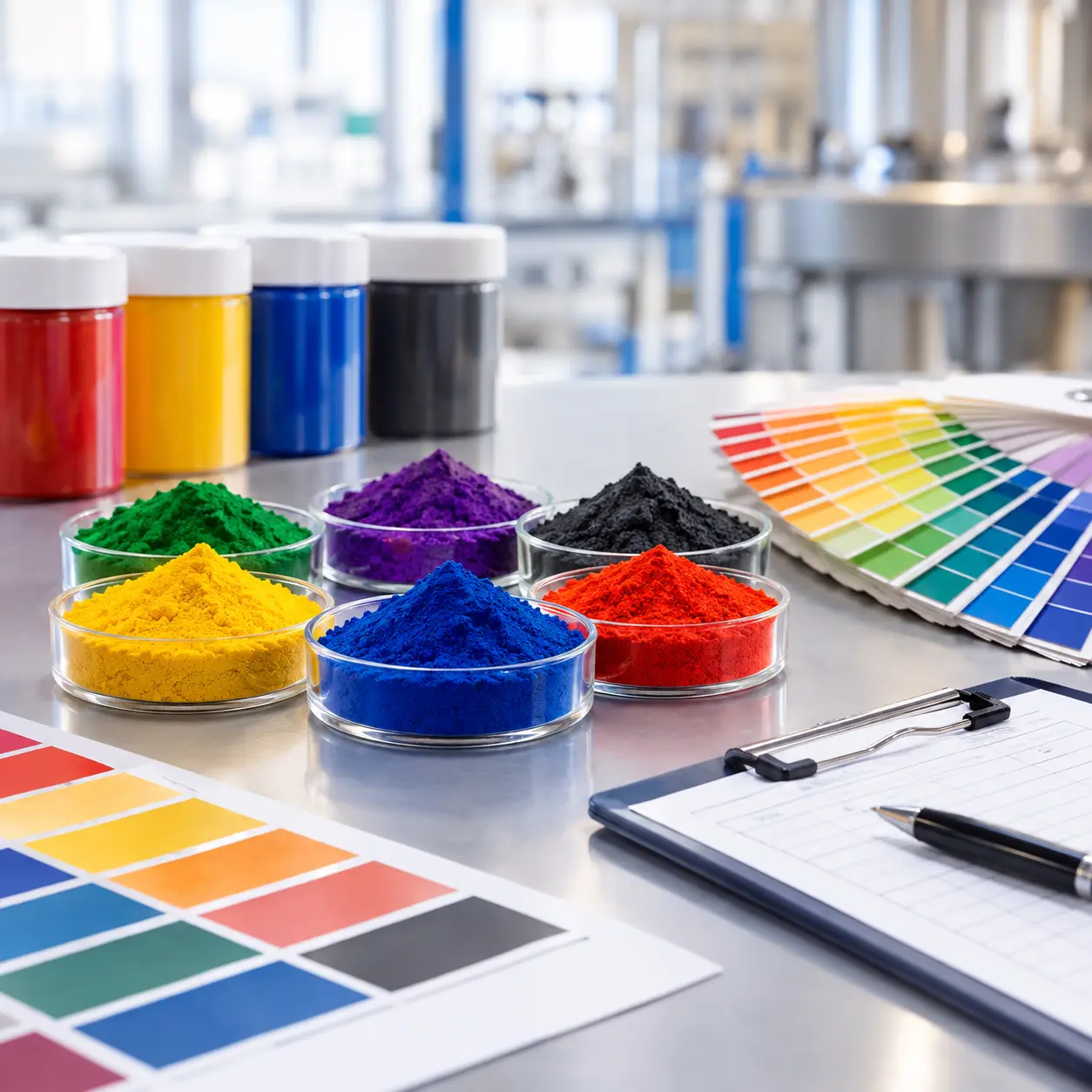
Pigments are solid colorants that impart color and specific optical properties to paint, dispersing within the liquid medium rather than dissolving. The type and quality of the pigment used in a paint formulation are key determinants of the final product's performance.
Incorrect pigment selection can lead to failure in achieving the desired color, insufficient opacity, color variations between production batches, or color loss in outdoor environments. Proper pigment selection helps achieve more consistent production results and ensures the product suits its intended application.
You can explore the pigment varieties offered for various applications to evaluate alternatives suited to your paint production requirements.
2. Opacity: The Hiding Power of Paint
Opacity refers to the degree to which a paint prevents the underlying surface or background color from showing through. It is an important performance criterion, especially in white paints, covering colored surfaces, and industrial coatings.
A pigment's light-scattering properties, refractive index, particle size, and dispersion within the paint can affect opacity. However, opacity is not solely determined by the pigment; the binder system, pigment volume concentration (PVC), and dry film thickness also dictate the final result.
What to consider when selecting pigments for opacity?
- Optical properties of the pigment: Light-scattering capacity plays a major role in the hiding performance of the paint.
- Particle size and distribution: Appropriate particle characteristics and good dispersion ensure efficient utilization of the pigment's optical performance.
- Formulation compatibility: The pigment must be compatible with the binder and other paint components.
- Application thickness: The same paint may show different opacity levels at different film thicknesses.
In white paints and applications requiring high opacity, titanium dioxide pigments are widely preferred. However, correct product selection must be made based on the paint type and targeted technical specifications.
3. Tinting Strength: Achieving Desired Colors with Less Pigment
Tinting strength refers to a pigment's capacity to affect color when mixed with another colorant under specific conditions. In paint production, pigments with high tinting strength can help achieve the target color shade at lower usage levels.
However, tinting strength does not depend solely on pigment concentration. The chemical structure, particle size, dispersion quality of the pigment, and the binder system used also influence the final result.
How does tinting strength affect paint costs?
Even if a pigment has a low unit price per kilogram, if a high amount is required to reach the target color shade, the total formulation cost may increase. Therefore, evaluating pigments not just by their unit price, but by the required usage amount to achieve identical color performance is a more accurate approach.
- Dosage efficiency: Affects the amount of pigment needed to reach the target color.
- Dispersion performance: Helps the pigment distribute homogeneously within the paint, influencing color consistency.
- Color reproducibility: Supports obtaining similar color results across production batches.
To evaluate different color options, you can explore our organic pigments and inorganic pigments categories.
4. Durability: Performance Against Light, Heat, and Chemical Effects
When selecting pigments in paint production, alongside the initial color, how well that color is maintained over its service life must also be evaluated. Durability against environmental conditions is a crucial criterion, especially for exterior paints, industrial coatings, and automotive applications.
Lightfastness and Weather Resistance
For paints exposed to sunlight and outdoor environmental conditions, the lightfastness and weather resistance of the pigment are vital. Unsuitable pigments may fade or undergo color changes over time. Technical data and application suitability of the pigment must be carefully checked for outdoor uses.
Heat Resistance
The thermal stability of the pigment must be considered in coatings exposed to high temperatures or production processes involving heat. The temperature a pigment can withstand varies depending on its structure and exposure duration.
Chemical Resistance
Industrial paints may come into contact with acids, alkalis, solvents, or various chemicals. In such applications, the chemical resistance of the pigment and its compatibility with other components in the paint system must be assessed.
Important: Rather than making generalized assumptions about a pigment's light, heat, or chemical resistance, it is essential to review the product's technical data sheet (TDS) and perform necessary performance tests.
5. How to Choose Between Organic and Inorganic Pigments?
Pigments used in paint production are generally classified as organic and inorganic pigments. Differences in tinting strength, opacity, durability, and cost can exist between the two groups. However, the outcome is not determined solely by which group the pigment belongs to; the specific properties of the product and the paint formulation are equally important.
- Organic pigments: Preferred in many applications to achieve vivid colors and high tinting strength. They offer options across various color groups such as red, yellow, blue, and green.
- Inorganic pigments: Stand out in certain applications due to their high opacity, covering power, and durability characteristics. Iron oxide pigments and titanium dioxide are examples of this group.
When making the right choice, target color, application conditions, technical requirements, and total cost of use should be evaluated together. For product alternatives, you can check out organic pigment varieties and inorganic pigment varieties.
6. Why is Pigment Dispersion Important in Paint Production?
Even if the correct pigment is chosen, if it does not disperse sufficiently within the paint, the expected color and performance may not be achieved. Dispersion is crucial for properly distributing pigment particles within the paint formulation and forming a stable structure.
Inadequate dispersion can lead to color variations, agglomeration, surface defects, and tinting strength falling below expected levels. Therefore, mixing and dispersion conditions during production must be controlled just as closely as pigment selection.
- Homogeneous color distribution: Helps achieve a consistent color appearance across different areas of the paint film.
- Efficient use of tinting strength: Supports more effective utilization of the pigment's optical properties.
- Surface quality: Proper dispersion can help reduce agglomeration and certain surface defects.
- Production consistency: Supports obtaining more reproducible results under similar production conditions.
Dispersion requirements vary depending on the pigment type, binder system, and equipment used. Therefore, conducting small-scale trials prior to production and determining appropriate process conditions is beneficial.
7. Pigment Selection by Paint Type
The intended location and conditions of paint application are decisive in pigment selection. Not all paint systems share the same color, opacity, and durability requirements.
- Interior and decorative paints: Color consistency, opacity, and application performance are paramount.
- Exterior paints: Lightfastness and weather resistance must be carefully evaluated.
- Industrial coatings: Chemical resistance, heat resistance, and suitability for the service environment are important.
- Automotive paints: Color accuracy, appearance, surface quality, and long-term durability requirements are taken into account.
- Metallic and effect coatings: Pearl and effect pigments can be evaluated to achieve special visual effects.
The suitability of a pigment for an application should not be determined solely by a color sample. Technical data sheets, formulation compatibility, and actual application tests should be evaluated together.
8. Common Mistakes When Choosing Pigments
Certain selection errors in paint production can adversely affect product quality and manufacturing costs. The following points should be kept in mind during purchasing and formulation processes.
- Focusing solely on price per kilogram: The pigment's usage rate, tinting strength, and performance must also be factored into the total cost calculation.
- Failing to check durability characteristics: Technical durability data must be reviewed, especially for outdoor and industrial applications.
- Disregarding dispersion performance: The pigment must be compatible with existing production equipment and the binder system.
- Skipping sample testing: Performing a small formulation trial before scaling up to large-scale production helps identify potential issues early.
- Not reviewing technical documents: The product's intended use, recommended conditions, and performance data should form part of the purchasing decision.
Frequently Asked Questions (FAQ)
Which is the best pigment in paint production?
No single pigment is the best option for every paint application. The right choice depends on the target color, opacity requirements, durability conditions, binder system, and cost targets.
Is a pigment with high tinting strength always more economical?
Not always. While tinting strength is an important criterion, the pigment's price, required dosage amount, dispersion performance, and final product requirements must be evaluated together.
Can organic and inorganic pigments be used together in the same paint?
Different pigment types can be used together in the same formulation provided their compatibility is verified. However, color harmony, dispersion, chemical compatibility, and final performance must be tested.
Why should sample testing be performed before selecting a pigment?
Sample testing helps evaluate the pigment's color performance, dispersion, and formulation compatibility under actual production conditions. Thus, potential issues can be identified before moving to large-scale production.
Conclusion: Consistent Paint Production Through Correct Pigment Selection
To achieve successful results in paint production, pigment selection must evaluate opacity, tinting strength, light and heat resistance, chemical compatibility, and dispersion performance collectively. The most appropriate pigment is not only the one that delivers the desired color, but also the one that meets the technical requirements and cost targets of the application.
You can explore product options for various applications through our organic pigments, inorganic pigments, and pearl and effect pigments categories.
As Tüver Pigment, we assist you in evaluating product alternatives tailored to your project's requirements in pigment supply for paint and coating applications. To get information about our products and supply options, you can contact us.